
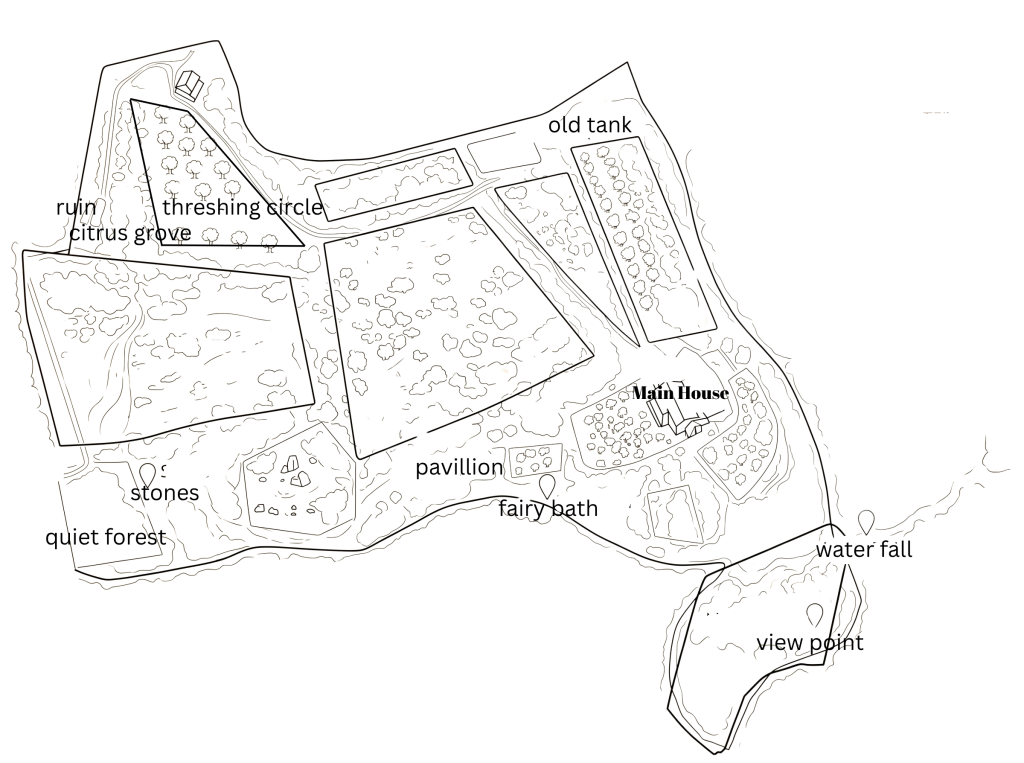
The main house sits at the centre of the farm (with two more houses on the land). Closest to the house are the areas that need the most regular attention: the vegetable and herb gardens, raised beds, food forest, and the everyday growing spaces.
Further out are mature olive terraces, medronho bushes, dry rocky areas, and old trees. Some areas are already useful. Some need care. Some are intentionally wild. The aim is not to force every part of the Quinta into production. The aim is to make each area clearer, healthier, and more useful over time to develop a healthy ecosystem in the valley where the Quinta is located.
The productive areas
The Kitchen Garden
The Kitchen Garden is the main vegetable garden near the house.
We originally experimented here with Gertrud Franck’s companion planting system, using mixed rows and plant communities rather than separate crop blocks. It was a useful experiment, but the invasive bracken became the real issue. It spreads strongly made open-bed growing difficult to manage.
The garden is now being rebuilt with raised beds as the main structure, combined with some open growing areas where they make sense. The aim is practical: a productive kitchen garden for herbs, salads, greens, seasonal vegetables, flowers, and companion plants.
The Market Garden
The Market Garden is the original vegetable garden of the Quinta. It complements the Kitchen Garden, but has a different role: the Market Garden is for lower-care crops that need more space or can grow with a simpler rhythm. This is where winter vegetables, beans, hardy crops, bulk crops, and longer-season plantings are at home.
In permaculture terms, the Market Garden is about matching the crop to the place. It is not as intensive as the Kitchen Garden, so it can work with broader beds, mixed plantings, ground cover, crop rotation, flowers, and plants that support soil life.
Forest Garden
The Forest Garden is a young perennial growing system. The aim is to create an edible, layered planting: fruit trees above, berry bushes and shrubs underneath, with herbs, flowers, groundcovers, and useful plants filling the lower layers.
It needs care now, especially as it got partially destroyed by boars recently. But the long-term idea is a system that becomes more resilient as the plants mature. This is one of the clearest permaculture areas at the Quinta: different plants growing together, supporting soil life, insects, shade, food production, and biodiversity in the same space.
The Current Project
Promiscua
The area known as “Promiscua” was probably the most important productive part of the farm in the past: It is completely terraced, but when I bought the Quinta it was so overgrown that the terraces were almost invisible. It has spectacular views towards Marvão, morning sun but is shaded from the hot afternoon sun.
The name Promiscua comes from coltura promiscua, a traditional Mediterranean way of growing different permanent crops together. Instead of separating olives, vines, fruit trees, herbs, and other useful plants, this approach works with co-planting: a mixed, productive landscape where different plants share space and create a more resilient system and support each other. Promiscua will become a mountain version of that idea. Old olive trees will be brought back into care. Vines can be added carefully. Mimosas need to be controlled. Soil needs protection. Shade, paths, access, and planting structure all need to develop slowly.
Promiscua brings together much of what the Quinta is about: food, wine, old trees, terraces, biodiversity, soil care, beauty, and useful work.
The Beautiful Wild
The Quinta has many areas that are just purely beautiful. Here are some of these stunning areas in pictures: